
About Us
 The Turbopan was designed by an Australian geologist and prospector with over 20 years experience in mineral exploration and gold prospecting. His first experience with gold pans was using traditional steel "Klondike" pans and plastic gold pans, whilst doing panned concentrate sampling surveys for alluvial and hard rock gold.
The process of panning down samples was slow and the results highly variable, depending on the skill and enthusiasm of the panner. He found that compaction of black sands often stopped gold getting to the bottom of the pan, and it could be lost if the panner wasn't careful.
Kim saw a need for a pan that would require a lot less technique, was easy for beginners to use, and could reduce a load of dirt quickly – whilst being cheap enough to be available to all budget sizes. He figured the necessary requirements of a better gold pan would be to
- get the gold to the bottom and into a trap as quickly and effectively as possible,
- get the waste out as quickly as possible whilst not losing any gold,
- and allow concentrates to be cleaned up quickly and effectively.
In 2000, Kim entered his first gold panning championship – the Far North Queensland Gold Panning Championship. He won the Men's Skilled event. He won it again in 2004, as well as winning a Queensland Championship in 2003. Kim entered his first World Gold Panning Championship in 2001, when it was held in Australia.

In 2004 he won the un-official category of Enduro Gold Panning at the World Championships, panning 80kg of dirt in 22 minutes. Kim has been a Grand Finalist at the World level 5 times, putting him in the top 30 gold panners in the World.
 After a couple of do-it-yourself attempts at building a gold pan, in 2005 Kim decided to get serious about designing a gold pan that could compete with the super-fast flat Finnish pans. More importantly it needed to be useful to prospectors and artisan miners who were forced to work in less than ideal conditions, often with less than ideal dirt.
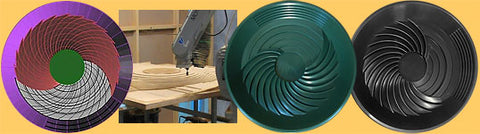
He gave the design parameters and some sketches to an engineer who specialised in CAD design for high tech surfboards, and had a computer controlled machining tool that cut the mould for the complex pan design quickly and easily (www.tromesdesign.com).
The first prototype worked – and showed the potential of the design – but had limitations. A second prototype was produced to overcome the limitations and it worked very well, but needed a bit of tweaking. The final Turbopan is developed from the third prototype!
All design parameters came about from rigorous testing in troughs and in the field. Importantly, the anti-clockwise swirling motion allows the full circumference of the pan to be used for waste ejection, which is a major advantage over the traditional "Klondike" pan, which tends to crowd the waste ejection over a small arc.
The Turbopan is also a product of solid customer feedback. Feedback led to more riffles in the sidewall, a strengthened rim for increased durability and a second, black Turbopan.
Now there is a brand new 25cm (10") Turbopan, ideal for all those tight spaces where you'd like to pan, but can't make the space. This pan is just the answer! Pan in a bucket or other small water vessel; pan in a crevice or cutaway where cutting away the rock is just too difficult; or pan in narrow creeks and streams where a larger pan would be burdensome.
In 2020 Kim sold the Turbopan business to Sojourn Enterprises Pty Ltd so he could free up his time to continue exploring and prospecting . To this day Turbopan continues to grow in acceptance from both domestic and commercial end users. Turbopan remains proudly Australian made and owned and continues to develop new prospecting accessories to compliment and complete the panning experience.
